
Scenario planning in the energy sector under uncertainty
2015 / 2018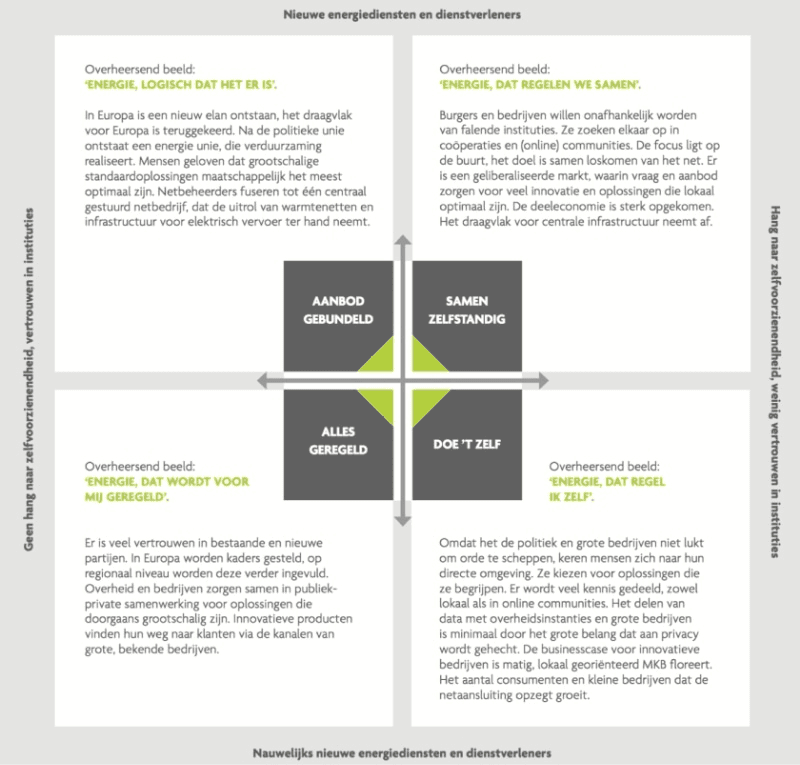
The world of energy is moving fast. How and at what speed the changes will play out cannot be predicted. That makes choosing a strategic direction complex. After all, what will our energy supply look like in 2030?
Enexis took a deep look at external developments and built four future scenarios for the possible shifts in the energy supply towards 2030. On the basis of the insights from the scenario study, Enexis made sharper choices about its own role in this changing world.
In 2018 Jester recalibrated the scenarios and developed an online Early Warning System that lets Enexis periodically poll 100 internal and external experts on which scenarios are gaining likelihood. This way Enexis continuously monitors the likelihood of the scenarios it has drawn.
Sander Molenaar, scenario-planning lead at Enexis: "Enexis has traditionally been a roadmap company: we mapped out our course for the next few years. But because of the energy transition, the future is uncertain; extrapolation is no longer possible. As a grid operator we have to take that uncertain future into account. Especially because we invest in public infrastructure with a very long lifespan, it is important to deal with this consciously. That is how we arrived at scenario planning."
Karin Smolders: "The scenarios have helped us enormously in conducting a sound strategic dialogue with stakeholders. Where we previously debated from conflicting visions, we now look together at challenges in the future. The scenarios are widely supported within the organisation. The asset-management team, for example, uses them to draw up the long-term grid investments."
Our strategy formation process unfolded organically. We started without a roadmap ready in advance. We always took a learning stance. That helped us make scenario planning our own and built support and commitment along the way.
"Thinking in scenarios has been a real turning point for Enexis. It created a shared, open perspective and, above all, trust."
– Karin Smolders, Senior Strategy Advisor at Enexis